

Overtime is a common requirement for many Perth businesses during peak periods, project deadlines, or unexpected staff shortages. While additional hours can support continuity and service delivery, overtime is regulated under Australian workplace law and must be managed carefully. Access to experienced HR Services Perth employers rely on helps ensure overtime decisions align with awards, contracts, and employee wellbeing.
What is overtime?
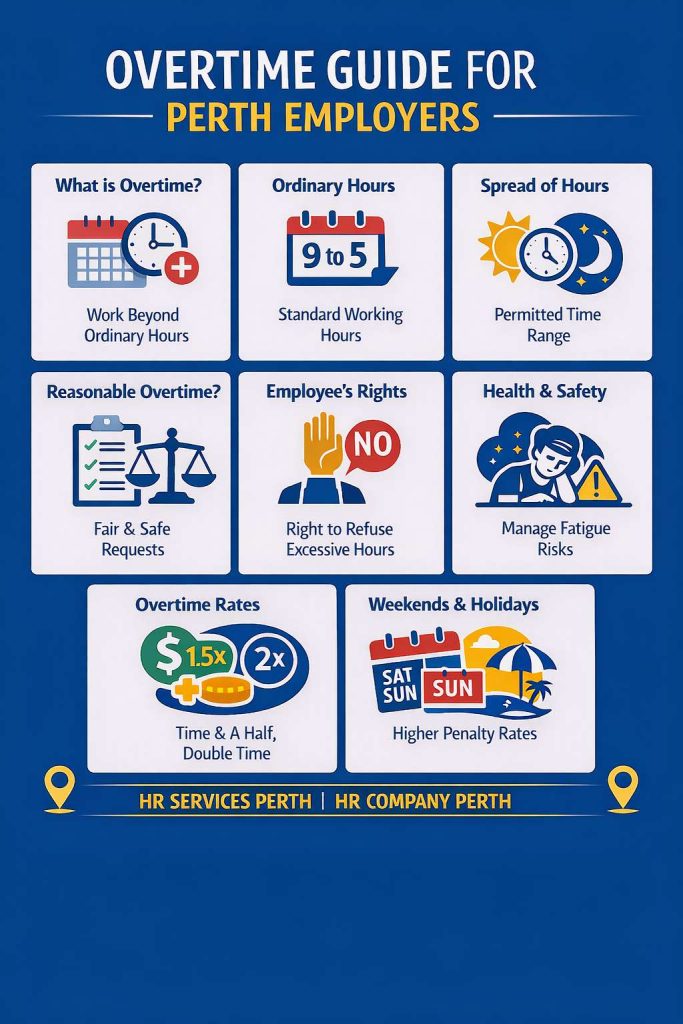
Overtime is any work an employee performs outside their ordinary hours of work. This includes hours worked beyond daily or weekly limits, hours exceeding a part-time employee’s agreed schedule, or work performed outside the permitted spread of hours. Overtime is not determined solely by total hours worked in a week; timing and employment classification are equally important. Employers should review applicable industrial instruments before approving additional hours to avoid unintended breaches.
What are ordinary hours?
Ordinary hours are the standard hours an employee is engaged to work. These are set out in modern awards, enterprise agreements, or individual employment contracts. Ordinary hours define not only the number of hours but also how they are structured across the week. For Perth employers, ordinary hours can vary significantly between industries such as construction, healthcare, hospitality, and professional services, making accurate interpretation essential.
Ordinary hours vs spread of hours
The spread of hours refers to the window during which ordinary hours can be worked, such as between early morning and evening. Even if an employee works within their total weekly hours, work performed outside the spread may still attract overtime or penalty rates. Employers must understand both concepts, as confusion between them is a common cause of payroll errors and underpayment claims.
Can employers require overtime?
Employers may request employees to work overtime, but the request must be reasonable. Guidance from the Fair Work Ombudsman confirms that overtime should not be imposed automatically or without proper consideration. Requests should be communicated clearly, with sufficient notice where possible, and supported by genuine business needs rather than convenience.
What is considered reasonable overtime?
Reasonableness is assessed by balancing business requirements with employee circumstances. Factors include the risk of fatigue or injury, the employee’s personal and family responsibilities, the frequency of overtime requests, and whether the employee receives appropriate compensation or time off. Employers should document how these factors are considered to demonstrate compliance if disputes arise.
Can employees refuse overtime?
Employees have the right to refuse overtime that is unreasonable or exceeds maximum weekly hours under the National Employment Standards. Refusals should not result in disciplinary action if they are lawful. Open communication and fair rostering practices reduce the likelihood of refusals and support positive employment relationships.
Health and safety considerations
Extended working hours increase the risk of fatigue, reduced concentration, and workplace incidents. Employers have a duty to manage these risks by monitoring hours worked, ensuring adequate rest breaks, and adjusting workloads where necessary. In Perth industries with physical or safety-critical roles, fatigue management is a key compliance and risk management issue.
How is overtime paid?
Overtime is generally paid at higher rates than ordinary hours, calculated as a multiple of the employee’s base hourly rate. Most modern awards require time-and-a-half for the initial overtime period and double time thereafter. Accurate timekeeping systems and award interpretation are critical, as incorrect overtime calculations are a common source of underpayment claims.
Weekends and public holidays
Overtime and penalty rates often differ for weekend and public holiday work. Many awards apply higher rates for Saturdays, Sundays, or public holidays, and shift workers may be subject to separate arrangements. Employers must review award clauses carefully, as these rates can significantly affect labour costs and payroll accuracy.
Managing overtime effectively
Clear overtime policies, consistent rostering, and regular payroll audits help Perth businesses manage overtime fairly and lawfully. Partnering with a professional HR company Perth organisations engage for compliance support can reduce risk, improve workforce planning, and provide clarity around award interpretation. With structured guidance from an experienced HR company in Perth and tailored HR Services, overtime can be managed as a strategic workforce tool rather than a compliance risk.