

In many Perth businesses, workload fluctuations are normal. Seasonal demand, project deadlines, or unexpected staff shortages often require teams to stay back and complete essential tasks. While this additional time is commonly referred to as overtime, the rules governing overtime are detailed and must be managed carefully within your human resources framework to remain compliant.
What Is the Definition of Overtime?
Overtime applies when an employee performs work outside their established ordinary hours. It generally includes work performed:
- Beyond an employee’s maximum daily or weekly ordinary hours
- Outside a part-time employee’s agreed pattern of hours
- Outside the applicable spread of ordinary hours defined in the relevant industrial instrument
What Are Ordinary Hours?
Ordinary hours are set under an award, enterprise agreement, registered agreement, or written employment contract. These instruments outline not only the number of hours considered ordinary but also conditions such as penalty rates, rostering rules, and flexibility arrangements.
How Does the Spread of Hours Differ From Ordinary Hours?
The spread of hours refers to the specific times of day when ordinary hours may be worked—for example, 7:00am to 7:00pm for many industries. Any work outside that defined span becomes overtime, even if the employee’s total daily hours do not exceed their usual number.
Can Employers Request Overtime?
Yes, employers may request overtime when operational needs arise. However, the Fair Work Ombudsman specifies that overtime requests must be reasonable. This protects employees from excessive workloads and supports a balanced working environment.
What Counts as “Reasonable” Overtime?
When determining whether overtime is reasonable, several factors must be assessed:
- Potential health & safety risks, including fatigue
- The employee’s personal circumstances, such as caring responsibilities
- The operational requirements of the business
- The notice provided by the employer
- Whether the employee’s contract or award already anticipates overtime
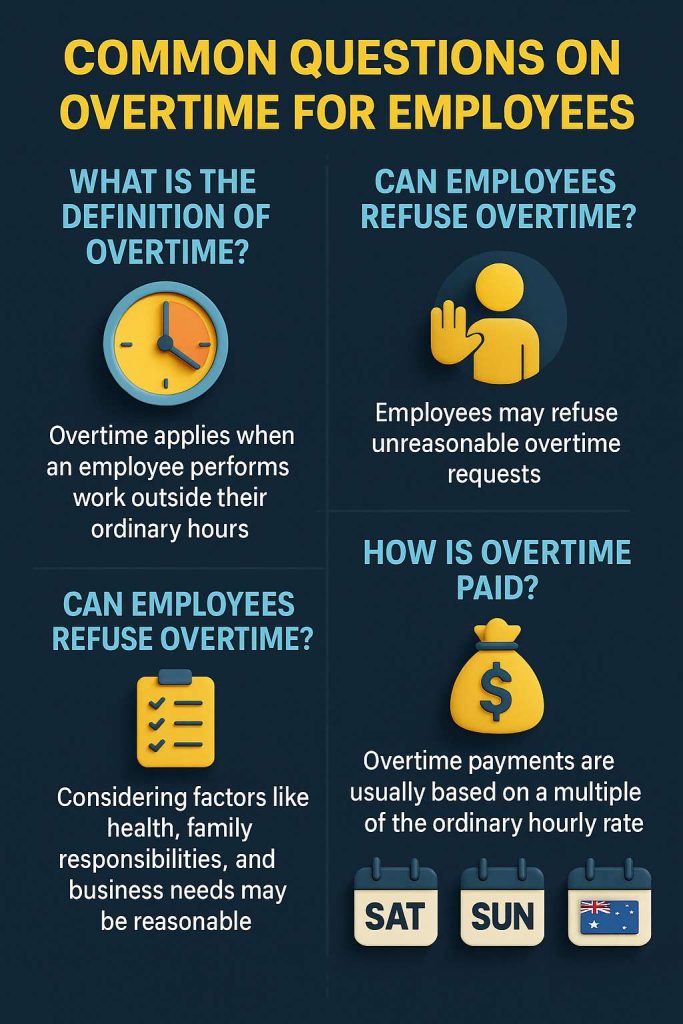
Can an Employee Decline Overtime?
Yes. Employees may refuse overtime if the requirement is unreasonable or if it exceeds the maximum weekly hours allowed under the Fair Work Act. Clear communication is vital, particularly in Perth workplaces where seasonal workloads (e.g., mining, construction, hospitality) can change rapidly.
Do Employers Need to Consider Health & Safety Risks?
Absolutely. Long hours and insufficient breaks increase the risk of fatigue-related incidents, especially in higher-risk sectors such as construction, maintenance, or driving roles. Businesses should implement structured fatigue-management practices and ensure overtime is rostered responsibly to meet Western Australia’s Work Health & Safety standards.
How Is Overtime Calculated?
Overtime payments are generally calculated as a multiplier of the employee’s ordinary hourly rate. Modern awards usually require:
- 150% (time and a half) for the first two or three hours of overtime
- 200% (double time) after the initial overtime period
These multipliers may differ depending on the applicable award or agreement, so Perth employers must review the exact industrial instrument covering their workforce.
What About Weekends and Public Holidays?
Some modern awards, particularly those relevant to Perth’s mining, transport, hospitality, and retail sectors, provide additional conditions for:
- Shift workers
- Saturday overtime
- Sunday overtime
- Public holiday overtime
Rates can vary significantly, so businesses should ensure payroll calculations remain accurate and up-to-date with award requirements.
Additional Guidance for Perth Employers
Given Western Australia’s diverse workforce and industry-specific demands, overtime practices require careful planning. Maintaining accurate timekeeping systems, documenting rostering decisions, and communicating expectations clearly reduces administrative risk.
Many businesses rely on HR Services Perth providers to help interpret award conditions, manage workforce planning, and ensure compliance. Engaging an experienced HR consultant Perth can support better decision-making, reduce exposure to underpayment claims, and improve operational efficiency.